Turn Clinical Evidence Into Better Development Decisions

Overview

Research Intelligence turns fragmented research data into a connected, queryable evidence model. Structured and unstructured information is organised around studies, interventions, populations, endpoints, results and publications, while preserving the relationships and provenance between them.

This evidence layer provides the foundation for similarity search, cross-study comparison, research interrogation, programme-level analysis and simulation. The architecture is source-agnostic, allowing the intelligence layer to be built around the research data available to each organisation.

Trial & Publication Evidence

Overview
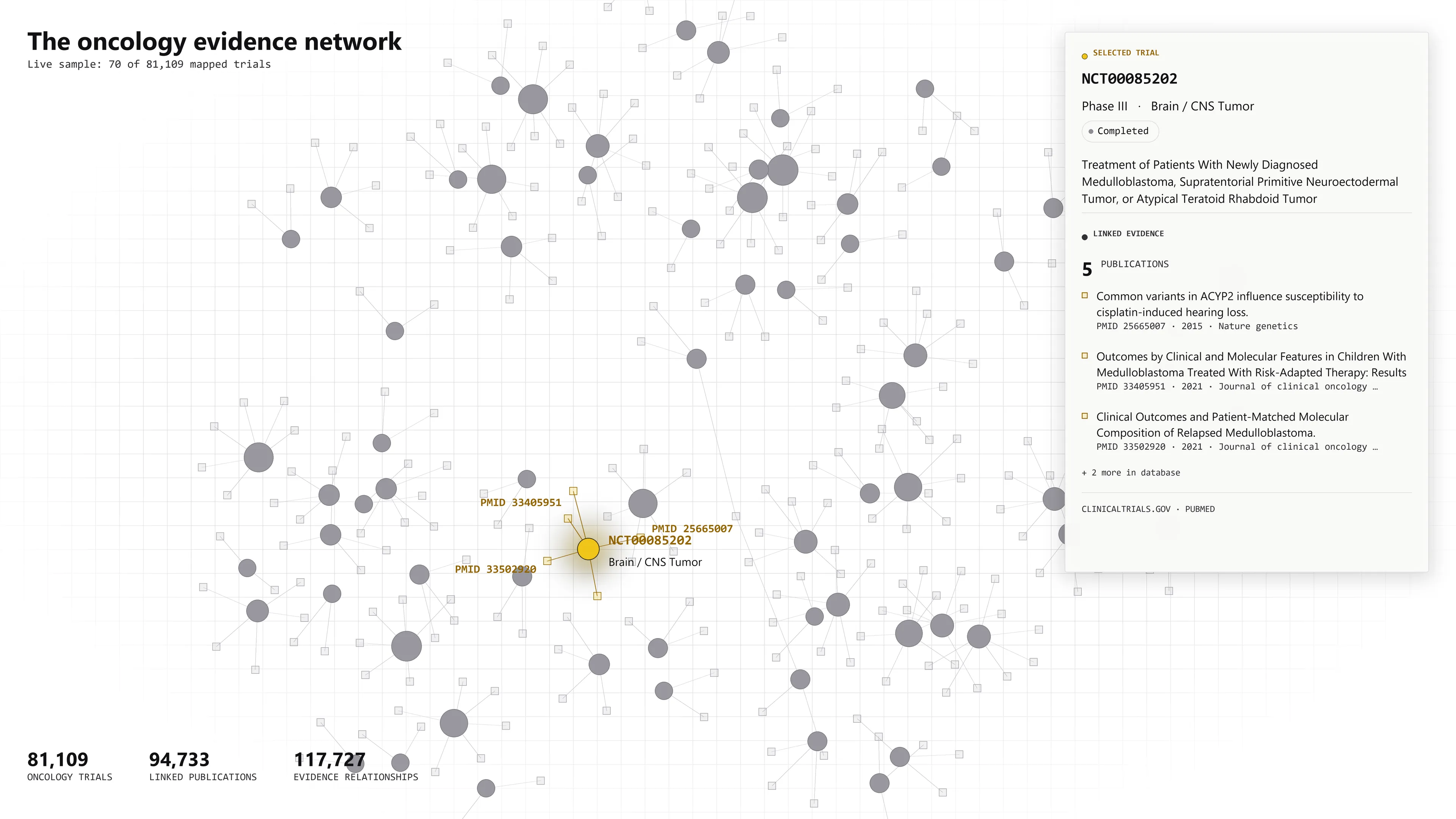
Bayezian transforms fragmented clinical trial and publication data into a structured evidence layer for pharmaceutical research intelligence. Trial records are connected to the scientific literature they generate, giving research teams a traceable view of clinical programmes, therapeutic areas and the evidence supporting them.
Connected evidence and traceability
Link clinical trial records with their associated scientific publications, including PMID and DOI identifiers, creating a traceable path from study design and development activity to published evidence.
Structured trial intelligence
Organise indication, phase, sponsor, intervention, population, endpoints, enrolment and study status into a consistent evidence layer that can be searched, compared and analysed across clinical programmes.
Landscape and competitive intelligence
Analyse activity across therapeutic areas, sponsors, interventions and development phases to understand the research landscape, benchmark competing programmes and identify emerging areas of clinical development.
Study precedent and evidence gaps
Examine previous trial designs, populations and endpoints to identify relevant precedents, understand where evidence is concentrated or limited, and support protocol research and clinical development planning.
Evidence Graph & Similarity

Overview
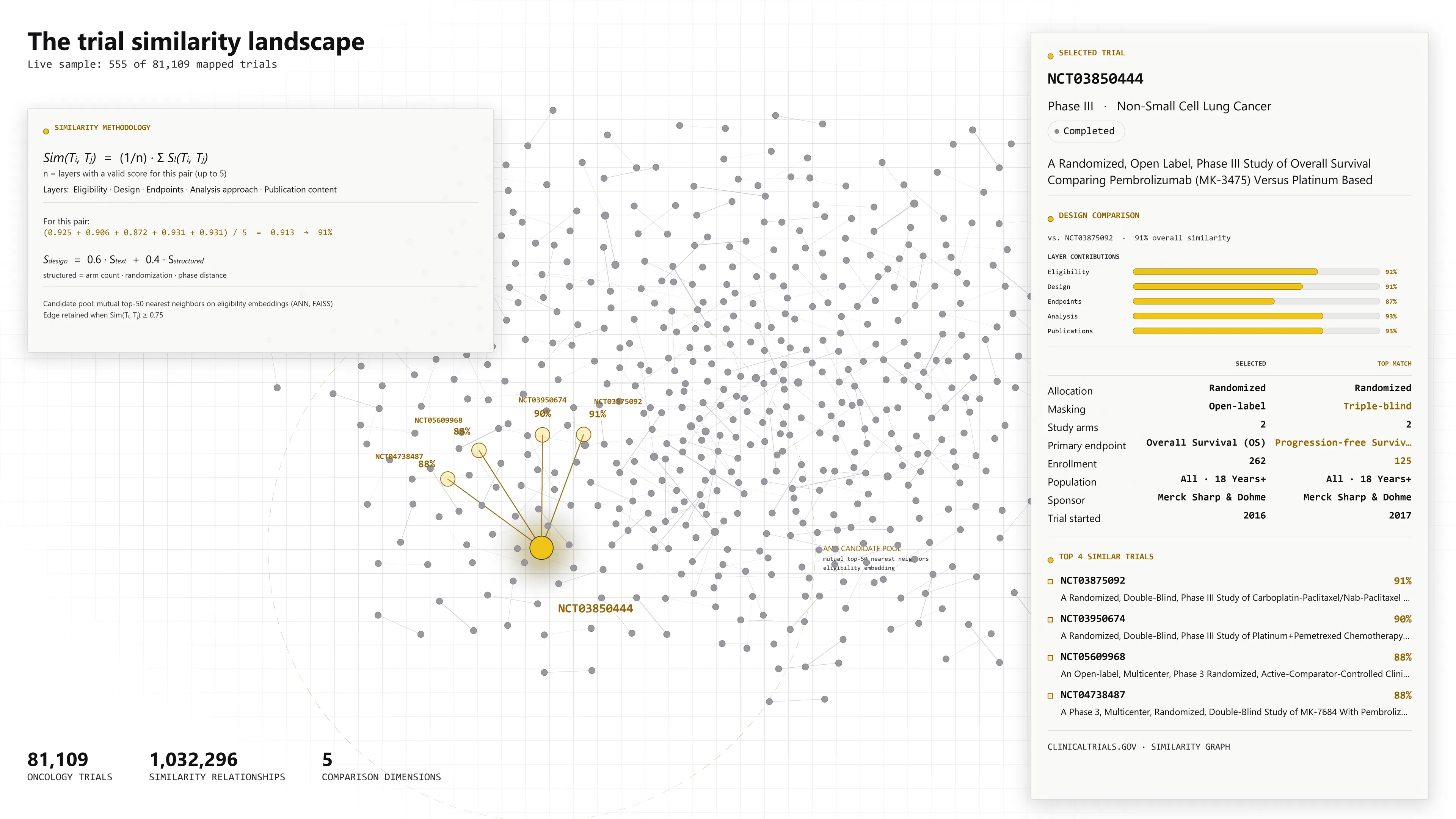
Bayezian maps relationships across the clinical trial landscape to identify studies that are most relevant to one another. By combining semantic and structured trial characteristics, the similarity graph helps research teams move beyond keyword search and understand how trials compare across design, population, endpoints and supporting evidence.
Multi-dimensional trial similarity
Compare studies across eligibility criteria, study design, endpoints, analysis approach and publication evidence to generate an overall similarity score and expose the factors driving each match.
Evidence graph exploration
Navigate from a selected trial to its closest related studies within a connected research landscape, helping teams identify relevant programmes, comparable trials and neighbouring areas of clinical development.
Structured trial comparison
Compare important study attributes, including allocation, masking, study arms, primary endpoints, enrolment, population, sponsor and trial timing, in a consistent side-by-side view.
Research and competitive intelligence
Use similarity relationships to identify study design precedent, benchmark competing programmes, discover relevant trials that may be missed by conventional search, and understand how development strategies differ across the clinical landscape.

Trial Research Assistance

Overview
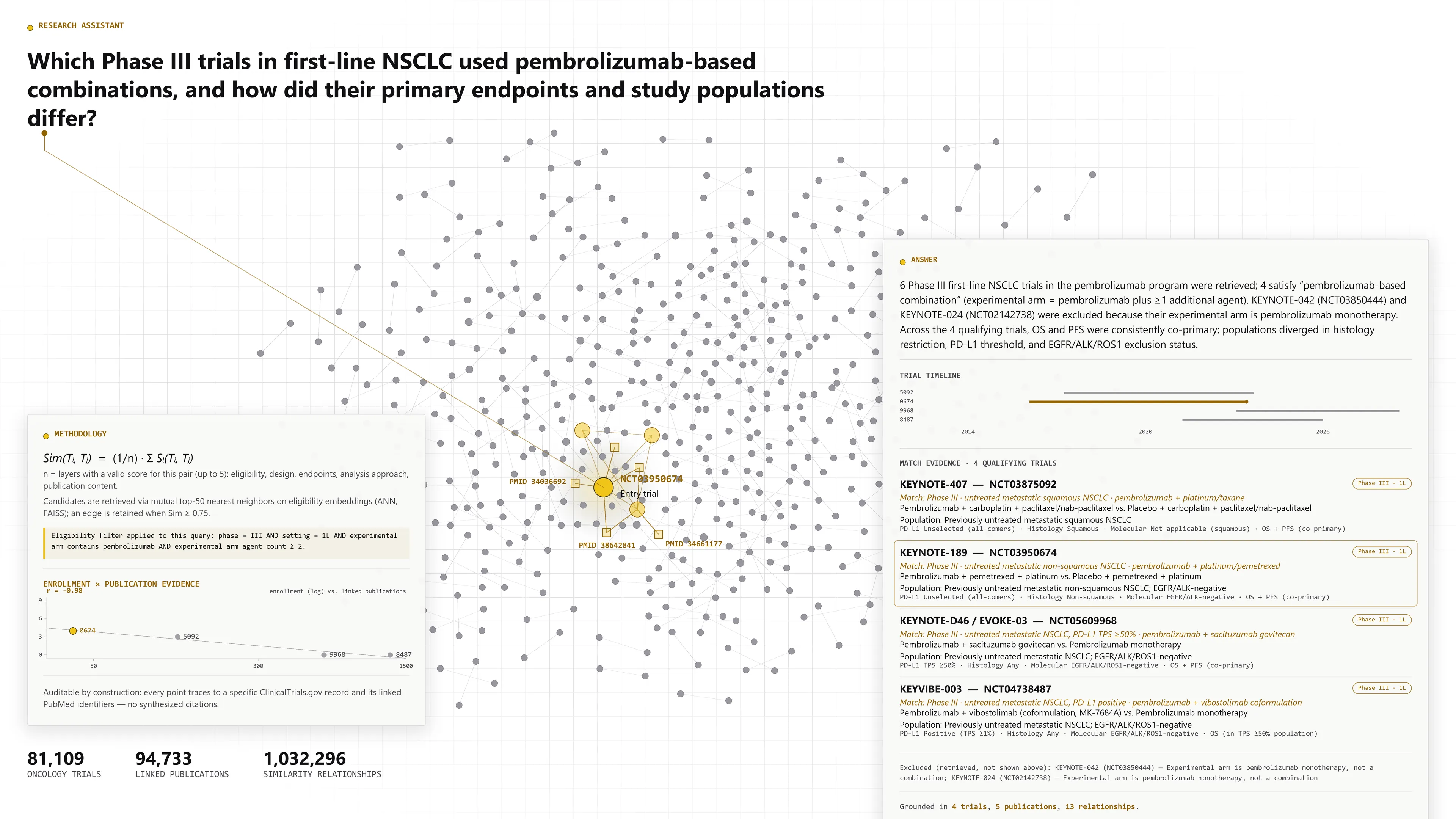
Bayezian maps relationships across the clinical trial landscape to identify studies that are most relevant to one another. By combining semantic and structured trial characteristics, the similarity graph helps research teams move beyond keyword search and understand how trials compare across design, population, endpoints and supporting evidence.
Multi-dimensional trial similarity
Compare studies across eligibility criteria, study design, endpoints, analysis approach and publication evidence to generate an overall similarity score and expose the factors driving each match.
Evidence graph exploration
Navigate from a selected trial to its closest related studies within a connected research landscape, helping teams identify relevant programmes, comparable trials and neighbouring areas of clinical development.
Structured trial comparison
Compare important study attributes, including allocation, masking, study arms, primary endpoints, enrolment, population, sponsor and trial timing, in a consistent side-by-side view.
Research and competitive intelligence
Use similarity relationships to identify study design precedent, benchmark competing programmes, discover relevant trials that may be missed by conventional search, and understand how development strategies differ across the clinical landscape.

Synthetic Trial Simulation

Overview
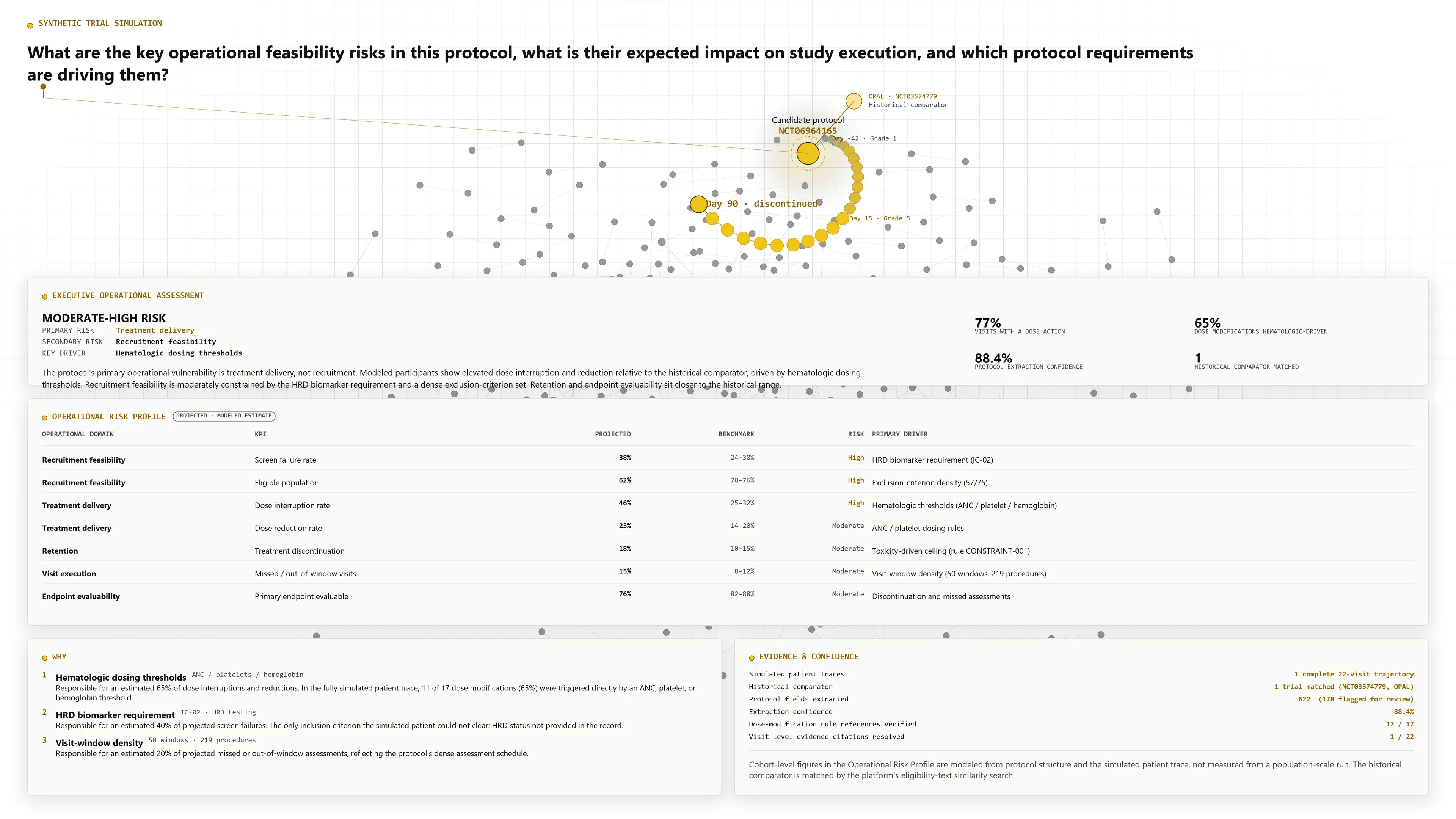
Bayezian uses protocol structure, historical comparator trials and synthetic patient trajectories to test how a study may perform before execution. The simulation translates protocol requirements into measurable operational effects, allowing teams to examine recruitment feasibility, treatment delivery, retention, visit burden and endpoint evaluability against relevant historical benchmarks.
Protocol-to-simulation modelling
Convert eligibility criteria, treatment rules, visit schedules, dosing thresholds and endpoint requirements into executable simulation logic that can be tested across synthetic patient journeys.
Evidence-informed assumptions
Use comparable historical trials and linked evidence to inform simulation parameters and benchmark expected behaviour, rather than relying on arbitrary assumptions.
Operational feasibility assessment
Estimate measures such as screen failure, eligible population, dose interruption, treatment discontinuation, missed visits and endpoint evaluability, then compare projected values with historical ranges.
Driver-level risk explanation
Trace projected risks back to the protocol requirements driving them, such as restrictive biomarker criteria, haematological dosing thresholds or dense visit schedules, so teams can see not only where risk may arise, but why.
Scenario testing before execution
Change protocol assumptions and rerun the simulation to examine how design choices may affect recruitment, treatment delivery, retention and data collection before those issues emerge in the live study.
RESOURCES

Exploring the Frontiers of AI

Our latest AI breakthroughs, client impact studies & research  from our incubator
View all resources

The Intelligence Layer for Clinical Development for Sponsors and CROs

Bayezian helps biotech and pharmaceutical companies understand what matters sooner, plan better trials, identify risk earlier and move development forward with greater confidence.
Get in touch.
Thank you! Your submission has been received!
Oops! Something went wrong while submitting the form.